
Greenville Tree Removal Team runs its tree planting service on the same principle as its removals: the decisions that matter are made before anything happens, and the expensive ones are made in the first ten minutes. Species, position and planting depth are settled at the estimate, on the specific ground and in the specific spot, rather than at a garden center on a Saturday.
Twenty years of taking trees down in this region is genuinely useful for putting them up. We have removed a great many trees that were planted three feet from a foundation, under a distribution line, or eight feet apart in a screen that was going to reach seventy. Nearly all of those were healthy trees killed by where somebody put them.
So we plant to mature dimensions and to the ground underneath. Piedmont ultisols here — the Cecil, Pacolet and Madison series — are deep, acidic and clay-heavy, with quartz and rock fragments in the upper horizon, and that changes both what thrives and how a planting hole should be prepared.
Choosing a Species for Piedmont Ground
Oaks and Long-Lived Shade Trees
White oak, southern red oak, scarlet oak and willow oak are all at home on this ground and all of them are decade-scale investments rather than quick shade. Water oak grows faster and is noticeably shorter-lived and weaker-wooded, which is worth knowing before it goes in near a house. Where the position will hold a large tree for fifty years, that is where an oak earns its place.
Understory and Smaller Flowering Trees
Not every gap wants a forest tree. Sourwood is a genuinely good native small tree for this region, eastern redcedar handles poor dry ground that defeats other species, and hackberry and sugarberry are tough urban performers where conditions are difficult. These are the trees that fit under a utility line or between a drive and a property line without becoming somebody’s problem in fifteen years.
Trees We Steer People Away From
Silver maple and sweetgum both grow quickly and both bring the problems that come with it — soft wood, surface roots, and in one case a fruit nobody wants on a lawn. Leyland cypress is planted as a hedge and becomes a tree with a shallow root plate. Callery pear, including the Bradford cultivar, is no longer sold in this state and should not be replaced with another one.
Right Tree, Right Place
Overhead Lines and the No-Grow Zone
The utilities across this service area publish planting guidance, and one cooperative here sets it out clearly: trees reaching around 40 feet planted at least 25 feet from overhead lines, larger trees at least 50 feet, shrubs kept 10 feet in front of equipment and 4 feet to the side. A tree planted inside those distances is committing somebody to a permanent pruning cycle, and it will not be pruned the way you would choose.
Foundations, Drives, Sewers and Septic
Roots go where water and air are, which is why they find a cracked lateral rather than causing one. Still, a large tree wants distance from a foundation, from a drive that will heave, and from a septic field it will colonize. We site the tree against those and against the mature crown spread, because the sapling in the pot gives no useful indication of either.
Spacing a Screen That Will Still Work in Fifteen Years
Most failed privacy screens here were planted at the spacing that made them look finished on day one. Given room, each tree fills out and the row closes properly; crowded, they shade each other, thin from the bottom, and lean as a group. We would rather plant fewer trees further apart and have you wait an extra season for privacy that lasts.
Planting Depth and the First Three Years
Finding the Root Flare Before Digging
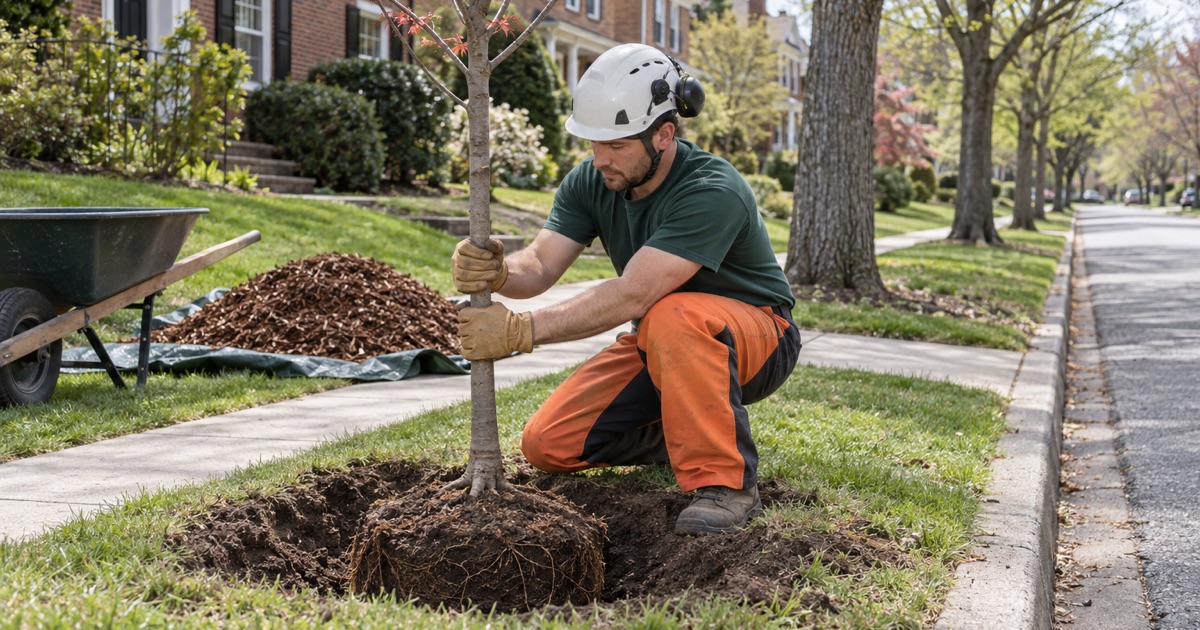
A large share of nursery stock arrives with the root flare buried in the container, and planting the pot at grade puts the flare inches too deep. That single error causes girdling roots, stem decay at the soil line and a slow decline nobody connects to planting day fifteen years later. We locate the flare first and set the tree so it sits at or slightly above finished grade.
The Hole, the Backfill and the Mulch Ring
On clay ground the hole wants to be wide and no deeper than the root ball, with the sides broken up rather than glazed smooth by a spade. Backfill is the native soil, not a bowl of amendment the roots will refuse to leave. Mulch goes on as a broad ring held well back from the trunk — piled against the bark it is a stated violation of the city’s landscaping ordinance, not merely bad practice.
Watering, Staking and Leaving It Alone
Establishment is a watering problem, and the schedule is fewer, longer soakings rather than daily sprinkling. Staking is for trees that genuinely cannot stand, and it comes off after a season, because a tree that sways builds the taper that holds it up. Formative pruning starts in year two or three, not at planting, when there is structure worth directing.
Replacement Planting After a Removal
Planting Where the Stump Was
A new tree in the footprint of an old one needs the stump ground deeper than a lawn does, and the grindings taken out rather than used as backfill, because decomposing wood chips tie up nitrogen exactly where the new roots have to work. We plan the grinding depth around the replanting when both are on the same job, which is cheaper than discovering the problem at planting time.
Mitigation and Canopy Replacement Requirements
Where a project falls under the city’s tree protection provisions, removal or injury of trees six inches in diameter at breast height or greater triggers replacement or mitigation equal to or greater than the cumulative diameter removed, with a fee-in-lieu route capped per acre and prorated by parcel size. Heritage trees carry an assessment on top. Planning the replacement planting alongside the removal is how that becomes a budget line rather than a surprise.
Replacing an Ash, and a Caution Worth Knowing
Emerald ash borer has been confirmed in Greenville County since 2017, which makes ash a poor choice for new planting here regardless of what a replacement list says. A local Bradford pear replacement list published in early 2026 offers green ash with no borer caveat attached, in a county with a nine-year-old confirmed infestation. We will tell you when a well-meant recommendation is one to leave alone.
- 20+ Years in the Upstate
- Free Estimates
- Written Tree Condition Reports