
Shrub removal sounds like the small end of what Greenville Tree Removal Team does, and on the invoice it usually is. On the ground it is frequently the messiest job on the schedule, because a foundation bed planted in 1974 is not a shrub — it is a woody root mass wound through a downspout, a hose bib and whatever the previous owner buried there.
So we price these on what is actually involved: the material above ground, the root balls below it, the access for getting the debris out, and the disposal at the far end. That last one is the item most quotes leave vague, and it is the one that moves the total.
The work splits three ways in practice. There are overgrown foundation and border plantings around a house; there are hedge and screen rows that outgrew the job they were planted for; and there is standing brush and undergrowth across part of a lot. They need different equipment and they price differently, and we say which one we think you have.
Overgrown Foundation and Border Plantings
Shrubs That Have Reached the Roofline
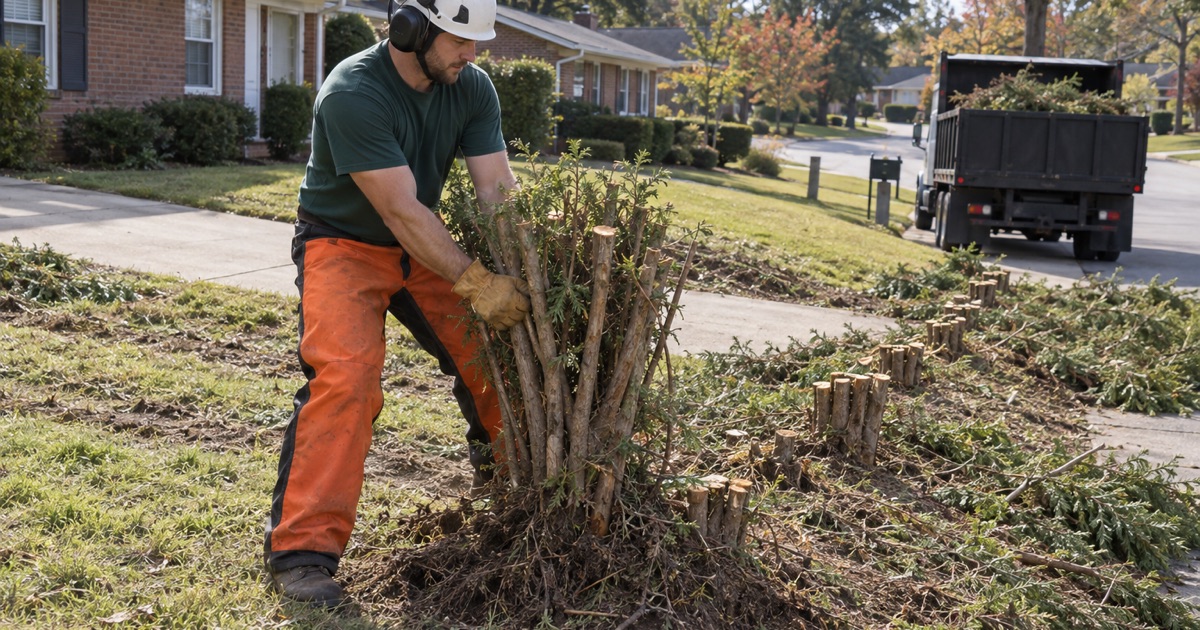
The evergreen planted as a three-foot ball beside the front steps is now above the gutter, hard against the siding and holding moisture on the wall behind it. There is no pruning route back to what it looked like, because these do not reliably resprout from old wood, so cutting into bare interior leaves a permanent hole. Removal and replanting with something scaled to the space is generally the honest recommendation.
Working Close to a Foundation
A root ball three feet from a wall gets cut and lifted out in sections rather than dragged, and anything running under a slab, a step or a walkway is severed cleanly and left rather than levered. Downspout extensions, irrigation lines, low-voltage lighting and gas runs to a grill all live in exactly this zone, and none of them are marked by a public locate. Walk them with us at the estimate.
Restoring the Bed Afterwards
Pulling forty years of shrub out leaves a bed that is part hole, part compacted subsoil and part builder’s rubble. Where something is going back in, that ground needs opening and amending rather than a bag of mulch over the top. We say in the estimate whether the bed is being left cleared, backfilled and graded, or prepared for replanting, because those are three different amounts of work.
Hedge and Screen Rows
Hedges Grown Through a Fence
A privet or holly line planted along a boundary and left for twenty years grows around, through and sometimes into the fence, until the two are structurally involved with each other. Taking the hedge out in that condition means working in pieces and expecting to find damaged panels underneath. We flag that before starting so the fence repair is a known cost rather than a complaint.
Leyland Cypress and Failed Screens
These get planted at hedge spacing and become trees with shallow root plates, dense canopies and a habit of leaning as a group once the row closes. By the time an owner calls, the bottom third is usually bare and one or two have blown over. Thinning to the sound specimens often restores a working screen for a fraction of the cost, and where the whole row is going the root plates make ground restoration the bulk of the job.
Replacing a Screen With Something That Fits
If the row is coming out and privacy still matters, the replacement conversation is worth having at the same visit rather than next spring. Fewer plants at proper spacing, chosen for the mature size the position can hold, produce a screen that closes properly and stays closed. That decision is easier to make while the old row is still standing and the failure is visible.
Brush, Undergrowth and Back Sections
Clearing Standing Brush and Saplings
An untended back section fills with saplings, vines and brambles, and the volume is always more than it appears from the house. Small stems come out at ground level or with the roots depending on what you want the ground to do afterwards, and anything above sapling size is handled as a removal. We walk the area and mark the boundary of the work so there is no ambiguity about where clearing stops.
Vines Through a Canopy
A heavy vine load adds weight and sail area to a tree that was not built to carry either, and on a mature specimen that matters in wind. Cutting the vines at the base and letting them die in place is usually better than pulling them out of the canopy, which tears bark and small limbs on the way down. We leave the dead material to break up rather than damaging the tree to make it tidy.
When a Forestry Mulcher Is the Better Tool
Past a certain area, hauling brush stops making sense. A forestry mulcher grinds standing brush and small stems where they stand and leaves the material as a mulch layer, which removes the loading, the truck movements and the tipping fee entirely. It also holds soil on the slopes this region is full of. We will tell you when the volume has crossed that line.
Roots, Disposal and the Ground Afterward
Woody Stumps and Resprouting
Most shrubs people want gone will come back from a cut stump, and some will come back from severed roots for a season or two. Taking the root ball out is what actually ends it. Where a stump is too close to a structure or a line to lift, we say so at the estimate and describe what will happen instead, rather than leaving you to discover the regrowth in spring.
Volume, Loads and What Disposal Costs
Shrub work generates a surprising amount of material for its footprint, and disposal is the line that moves the total. Greenville County charges by the cubic yard for a small vehicle and by the ton at the tipper, with penalties for unseparated loads, while the county to the north runs a different gate on a different basis. Contractor-cut material is not a curbside item anywhere here.
Grading, Seeding and What You Are Left With
A cleared bed or a cleared back section is not a finished surface, and saying so up front avoids the most common disappointment in this work. We state whether the estimate ends at cleared and raked, or includes bringing the ground back to grade and seeding it. Both are legitimate; only one of them costs what people expect.
- 20+ Years in the Upstate
- Free Estimates
- Written Tree Condition Reports