
Land clearing with Greenville Tree Removal Team starts with a walk of the parcel and a plan for what stays, across Greenville, SC and out to Gantt, Mauldin, Five Forks, Powdersville and Simpsonville. Twenty years of this work in the Upstate has settled one thing: the expensive mistakes on a clearing job are made in the first hour, when somebody decides where the machines will drive and which trees are being kept.
The two questions that follow are regulatory and logistical. Greenville County Code requires a tree protection plan drawn at the same scale as, and superimposed on, the development site plan or preliminary plat, with its own application, exemptions and tree credit provisions — county instruments that do not reach land inside the city, where a separate ordinance governs. Getting the right one applied to the right parcel is the difference between a clean job and a stop-work conversation.
The logistical question is what happens to the material. Forestry mulching leaves it on the ground as a mulch layer and removes the haul entirely; conventional clearing turns it into loads bound for a gate that prices by the ton or the cubic yard. Both are legitimate, and which is cheaper depends on the stems on your lot, not on a rule of thumb.
Forestry Mulching
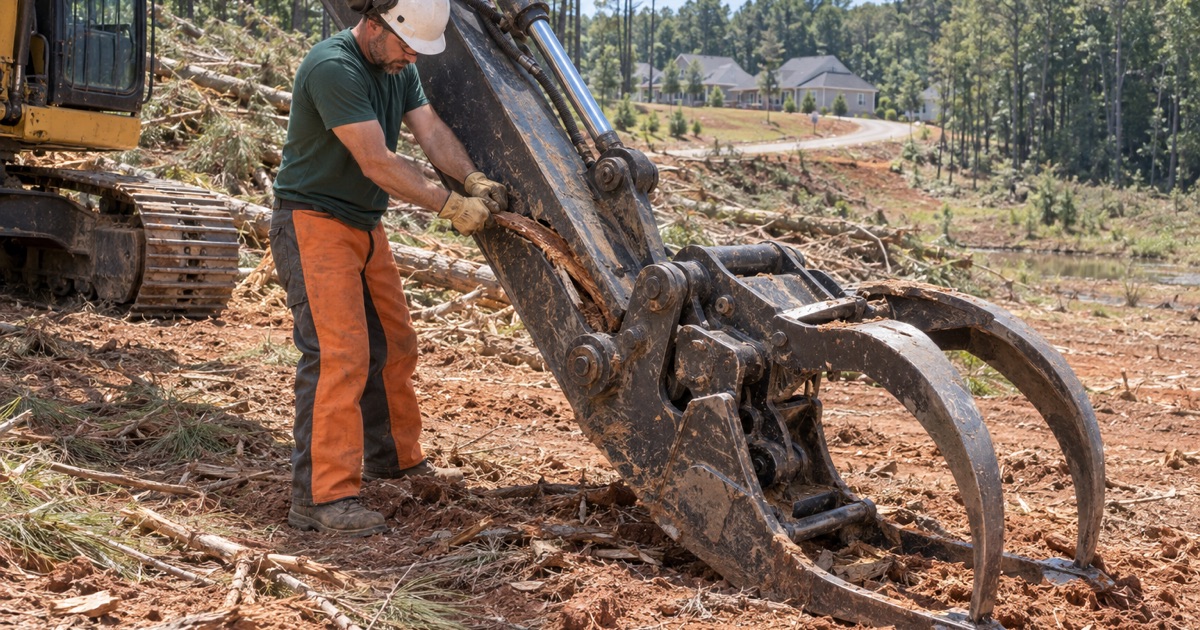
What a Forestry Mulcher Does
A forestry mulcher is a tracked carrier with a rotating drum of fixed teeth that grinds standing brush, saplings and small stems into chips where they stand, in one pass, with no separate cutting, piling or loading step. The material lands as a layer across the worked area. Because nothing leaves the site there is no haul, no tipping fee and no procession of trucks, which is where the cost difference against conventional clearing mostly lives.
Where Mulching Is the Right Tool
Overgrown back sections, fence lines, trail and drive corridors, pasture reclamation, and understory work under a canopy you intend to keep are all natural fits. It is also the honest answer for a wooded lot where the owner wants access and sightlines rather than a bare pad. What it is not is a solution for a single large specimen tree, or for a parcel carrying mature timber above the drum’s working diameter — those are removals, and we price them as such.
The Mulch Layer, Erosion and Regrowth
The layer left behind does real work on Piedmont ground. Pacolet slopes across this region commonly run 15 to 25 percent, and a scraped lot on that gradient loses soil in the first heavy rain in a way a mulched one does not. The layer also suppresses regrowth while it breaks down, though anything with a live root system underneath will eventually come back, so a maintenance pass every couple of years is normal rather than a sign something went wrong.
Conventional Clearing and Where the Material Goes
Grubbing, Stumps and a Buildable Pad
Where something is being built, the requirement is usually a clean pad rather than a mulched surface, which means stumps out or ground well below grade and root mats removed. That is machine time plus material volume, and the volume is what drives the invoice. We say in the estimate whether stumps are ground or excavated and to what depth, because those two words describe jobs that price very differently.
Hauling, Tipping and the Gate Behind the Job
Cleared material becomes a disposal problem the moment it is loaded. Greenville County charges $5.00 per cubic yard for a small vehicle and $32.50 per ton at the tipper, with tree stumps and root mats named on its own schedule and unseparated loads carrying a penalty per ton, and commercial haulers are directed to a specific landfill. The county to the north runs a different gate on a different basis. We price disposal against the site’s actual destination rather than a regional average.
Burning, Chipping and On-Site Options
Some of the volume can often stay: chipping brush for use on the property, retaining usable trunk lengths for a landowner who wants them, or windrowing material at the back of an acreage parcel where that is permitted. Open burning is governed separately and by more than one authority, so we tell you what applies rather than assuming it is available. Every option that keeps material on site takes tonnage off the disposal line.
Protecting What You Are Keeping
Critical Root Zones and Where Machines May Not Go
The governing definition of a critical root zone in the city is a circle whose radius in feet equals the trunk diameter in inches, so a 40-inch tree carries a 40-foot protected radius. Inside that circle, driving, parking, stockpiling and trenching are all forms of damage, and compaction is the one nobody sees happen. Marking those circles before the first machine moves is the cheapest step in a clearing job and the one most often skipped.
Tree Protection Fencing That Actually Complies
Where protection is required, the city’s specification is particular: fencing at least four feet high, of wood or metal, completely encircling the critical root zone before earth is disturbed and remaining for the duration, with silt fencing expressly not acceptable as tree protection. Signs of at least one foot by 1.5 feet reading TREE PROTECTION ZONE: KEEP OUT are required in English and Spanish on all sides and every 300 linear feet. Getting this wrong is a correctable failure before work starts and an expensive one afterwards.
Mitigation, Tree Credit and Canopy Replacement
On development and land-disturbing activity inside the city, removal or injury of trees six inches in diameter at breast height or greater triggers replacement or mitigation equal to or greater than the cumulative diameter removed, with a fee-in-lieu route that is capped per acre and prorated by parcel size. Heritage trees carry an additional per-caliper-inch assessment on top of that. Counting the trees before they come down is how a clearing budget avoids a mitigation bill nobody modeled.
Planning a Clearing Job Before the Machines Arrive
The Walk, the Marking and the Written Scope
We walk the parcel with you, mark what stays, identify the access route, note the wet ground and the slope that will decide where a machine can work, and write all of it down. The scope names the area in defined boundaries, the treatment for each part of it, the stump treatment and the disposal route. Ambiguity on a clearing job gets resolved by whoever is holding the controls, which is not where that decision belongs.
Utility Locates and Buried Surprises
South Carolina 811 goes in before ground is broken and the marks come back in working days, which sets the earliest realistic start. Public utilities are located through that process; private lines are not, and older Upstate parcels carry plenty of them — abandoned field lines, irrigation mains, a gas run to a barn, low-voltage cable to a gate. Walking those with us during the estimate is worth more than any allowance we could put in the price.
Access, Slope and What the Site Will Take
A parcel that reads as straightforward on a map can be awkward on the ground: a single narrow entry, a soft crossing, a bank too steep to work across safely. Tracked equipment handles a great deal here, and there is still a point at which the answer is a smaller machine and more days. We would rather tell you that at the estimate and price it honestly than start on optimism and come back for more.
- 20+ Years in the Upstate
- Free Estimates
- Written Tree Condition Reports