Greenville Tree Removal Team approaches tree disease treatment the same way in every case: find out what is actually wrong before prescribing anything. Most trees we are called to look at in decline are not diseased in the way the owner assumes. They are trees whose root zone has been changed — graded, compacted, buried, cut through for a driveway — and the crown is simply reporting it three years later.
That matters commercially as well as horticulturally, because the treatments sold for a declining tree are frequently aimed at symptoms rather than at the cause. A tree failing because its flare is nine inches under mulch does not improve with anything applied to the leaves, and the money spent finding that out is a fraction of the money spent not finding it out.
We also state clearly what we do not do. Commercial pesticide application is separately licensed in this state through Clemson’s Department of Pesticide Regulation, and where a problem genuinely calls for that we say so and point you to it. What we bring is diagnosis, structural work and cultural care.
Diagnosis Before Anything Is Prescribed
Starting at the Root Collar
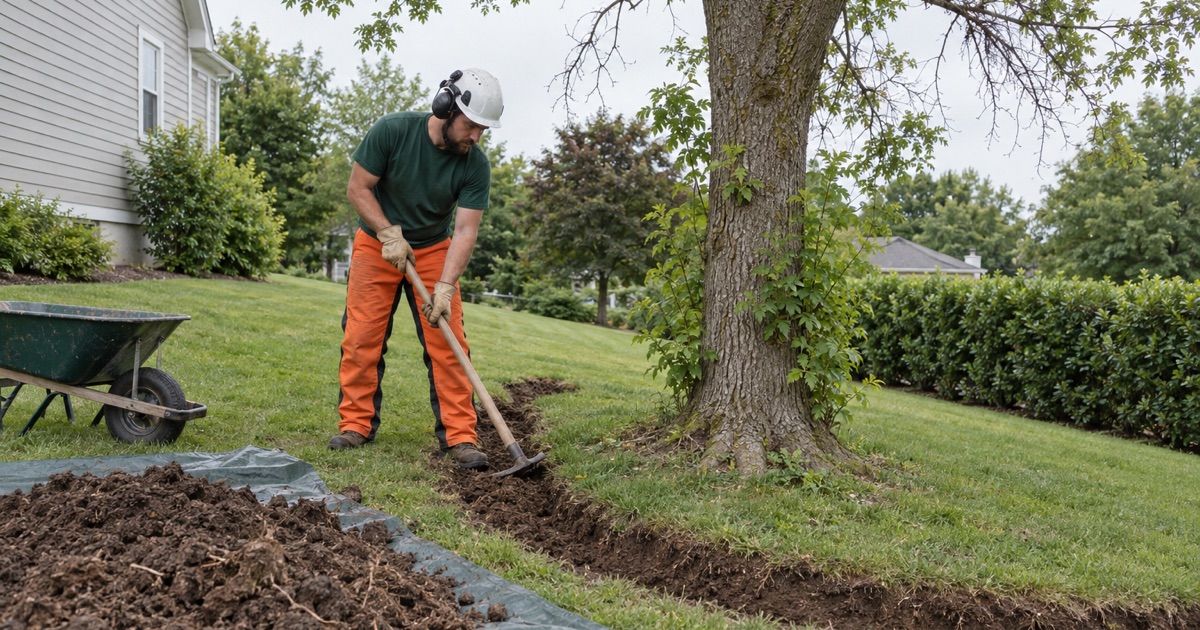
The first thing we look at on a declining tree is the base, because that is where the majority of answers are. Root collar excavation with an air spade moves soil using compressed air and leaves the roots themselves intact, exposing girdling roots, decay at the buttress, and flares planted or buried far too deep. None of that is visible from the driveway, and all of it changes the diagnosis completely.
Reading the Crown as a Symptom, Not a Cause
Thinning, early color, dieback at the tips and small leaves are all real information and none of them name a cause on their own. What tells you something is the pattern: dieback starting at the top and moving down reads differently from dieback on one flank, which reads differently again from a uniform thin canopy. We record the pattern and work backwards toward the part of the tree that is actually failing.
The Site History Nobody Mentions
A large share of declines trace to something that happened two or three years earlier — a driveway widened, a pool dug, a lot regraded, a trench run for a line. Roots severed on one side or soil compacted under repeated machine traffic produce a decline with no visible cause by the time anyone calls. Asking what changed on that ground is a diagnostic step, not small talk.
Insect Pests in Upstate Trees
Emerald Ash Borer
Emerald ash borer has been present in Greenville County since August 2017, and any ash in decline here starts with that as the leading candidate. The sequence runs from thinning at the top of the canopy through epicormic shoots on the trunk to D-shaped exit holes and heavy woodpecker stripping. The practical consequence is that a killed ash goes brittle fast, which changes whether the tree can be climbed at all and pushes the removal cost upward the longer it stands.
Southern Pine Beetle
Pitch tubes on a pine trunk are the tree’s attempt to push boring insects back out, and once the crown starts moving from green through yellow to red the outcome is settled. The question that matters at that point is the rest of the stand, because these do not stay in one tree. Removing a confirmed infested pine promptly is about the neighbors as much as about the specimen in front of you.
What Insect Damage Does and Does Not Explain
Borers of most kinds are opportunists that succeed on trees already weakened by something else, so finding them is often the second half of the answer rather than the whole of it. A tree colonized after two years of drought and root damage has an insect problem and a site problem, and treating one without the other buys very little. We say which we think is primary.
Decay, Defects and Structural Problems
Conks and Root Rot at the Buttress
Fruiting bodies at the base indicate decay already established in the structural roots and the butt of the trunk, in the part of the tree that holds everything up. We excavate to see the extent and map it against the load path, because decay on the tension side of a leaning stem is a materially different finding from the same decay on a buttress carrying nothing. That mapping is what produces a recommendation rather than an opinion.
Cankers, Wounds and Included Bark
A canker is a localized dead area in the bark and the wood beneath it, and its significance depends almost entirely on where it sits and how much of the circumference it involves. Old pruning wounds that never closed, mower damage at the base and included bark in a major union all belong in the same assessment. Structural defects and disease are read together, because the tree does not distinguish between them.
When Decay Means Removal
There is a point at which the honest answer is that the tree comes down, and pretending otherwise costs an owner money and eventually costs them the thing under the tree. Extensive decay in the structural roots is that point. We would rather say it plainly, price the removal alongside whatever monitoring is realistic, and leave you to decide, than sell a treatment plan for a tree we would not park under.
Soil, Compaction and the Care That Actually Helps
Decompaction and Radial Trenching
Compacted soil starves roots of oxygen and water, and it is the most common addressable problem on established Upstate lots. Radial trenching with an air spade opens narrow channels running outward from the trunk and backfills them with amended soil; broader decompaction treats the whole root area. Results come slowly compared with anything visible, and they are durable in a way that nothing applied to the canopy is.
Correcting a Buried Flare and Girdling Roots
A flare buried by years of mulch, settled soil or a bed built up against the trunk rots at the soil line and grows roots that eventually strangle the stem. Excavating back to the flare and severing the girdling roots that can safely be cut is genuine treatment, and on a young or middle-aged tree it changes the trajectory. The one thing to avoid is piling mulch against the trunk again afterwards, which the city’s own landscaping ordinance treats as a violation rather than a bad habit.
Pruning as Part of Recovery
Pruning does not cure disease, and heavy pruning on a stressed tree makes it worse by removing the live crown it needs to recover. What pruning does well is take out genuinely dead and broken wood, reduce a limb that has become a leverage problem, and open a structure that has become a liability. On a declining tree we do the minimum that helps and leave the rest alone.
- 20+ Years in the Upstate
- Free Estimates
- Written Tree Condition Reports