
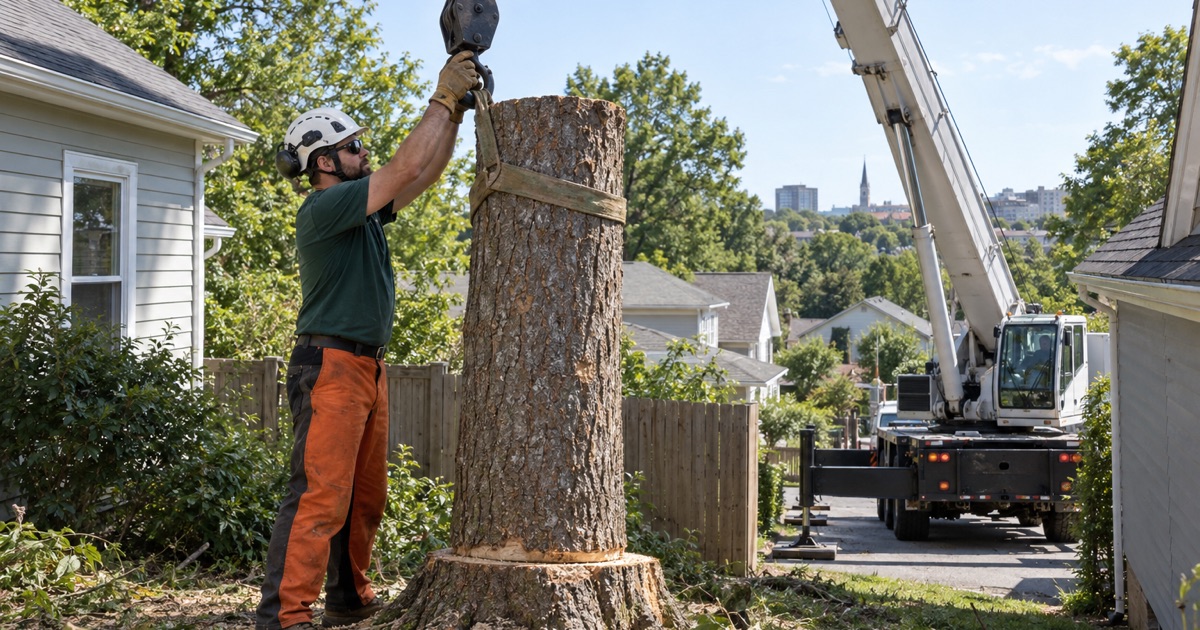
Crane tree removal is what Greenville Tree Removal Team reaches for when the tree is bigger than the space around it. That is a common situation here rather than an exotic one: the mill-village streets and the housing built through the 1960s were planted with the houses, and those trees have matured over narrow lots with the canopy directly above a roof.
A crane changes the problem. Instead of dismantling a tree from inside it and lowering every piece past the thing you are trying to protect, the pieces are cut and lifted away vertically, over the house rather than through the garden. On the right tree that is faster, considerably safer and less damaging to everything underneath.
It is not the right answer everywhere, and we say so. A straightforward tree in an open yard does not need a crane, and putting one there adds mobilization and setup to a job a climber would already have finished. Our estimates carry both prices when both are genuinely viable.
When a Crane Is the Right Call
Mature Canopy Directly Over a Structure
A large limb removed conventionally has to travel somewhere, and above a roof the options are lowering it through a gap that may not exist or cutting it small enough to control by hand. A crane takes the weight before the cut is finished and carries the piece out over the ridge. On a mature hardwood leaning toward a house, that is the difference between a controlled morning and an afternoon of small careful compromises.
Trees With Compromised Structure
A tree a climber should not be in — extensive decay at the base, a cracked union, a storm-loaded stem, a dead and brittle ash — is a crane candidate on safety grounds alone. The crane can also hold a stem while it is cut, which matters when the failure surface is the reason the tree is coming down. We would rather charge for the machine than send someone up something that has already told us what it intends to do.
Tight Lots and Nowhere to Drop
Some removals fail on the ground rather than in the tree. A back yard with a pool, a deck, a greenhouse and a neighbor’s fence has no landing zone, and every piece lowered has to be received by hand. Lifting the material out to a street position removes the ground problem entirely, and on a full day it usually removes more cost than the crane adds.
Planning the Picks Before the Crane Arrives
Weight, Reach and the Chart
Every pick is a weight at a radius, and capacity falls away as the boom extends. We estimate piece weights from species, diameter and length, check them against the machine’s chart at the distance the setup actually allows, and size the cuts to that answer rather than to what looks convenient in the tree. Getting this wrong is not a scheduling problem; it is the failure this planning exists to prevent.
Rigging Points and the Order of Cuts
Pieces are picked in an order that keeps the remaining tree stable and keeps the load line clear of what is left standing. The rigging point goes above the center of mass so the piece hangs the way the climber expects when the cut releases, which is what stops it swinging into the roof it was lifted over. That sequence is worked out on the ground, in advance.
The Ground Crew and the Landing Zone
A crane job needs somewhere to put what comes out, and a clear route from there to the chipper and the truck. Establishing the landing zone, the exclusion area beneath the load path, and who is calling the lift is part of the setup rather than an afterthought. Nobody stands under a suspended piece, including the owner who wants to watch.
Setup, Access and the Street
Outriggers, Pads and What the Ground Will Take
Outrigger loads are concentrated enough that where a machine sits is a genuine engineering question rather than a parking preference. Pads spread that load, and residential driveways frequently cannot take it regardless. We work out the position during the estimate and tell you plainly what marking or repair is likely if the setup is anywhere other than the road.
Lane Closures and Local Notification
A street setup usually means closing a lane, and this service area crosses five counties and a large number of municipalities that each handle that differently. Arranging it belongs to the week before the job, not the morning of it. Where a site needs a closure that a jurisdiction will not grant on the day you want, we would rather know at the estimate.
Overhead Lines Above the Setup
A crane working near energized conductors is governed by the ANSI Z133 safety requirements, and the presence of a line over the setup position can rule that position out completely. We identify the provider serving the address, establish what is overhead and where, and plan the position and the load path around it. Weather limits apply to the lift as well: ice, high wind and thunderstorms in the area stop the work.
Crane, Climbing or Lift
Conventional Climbing and Rigging
Most removals here still come down by climber. Pieces are cut and lowered under control with a bull rope through a rigging block and a friction lowering device at the base, sized so the working load limit of every component has real margin. It needs room at the base and it needs a competent ground crew, and on a straightforward tree it is both quicker and cheaper than mobilizing a machine.
Spider Lifts and Tight Access
Where a tree cannot be climbed safely but the site will not take a crane, a tracked spider lift can sometimes get an operator into position through a gate that would stop a bucket truck. It is slower than a crane and far kinder to a lawn than a wheeled machine. On dead or brittle trees in back gardens it is regularly the only route that is both possible and sensible.
How We Decide, and What You Are Shown
The method is settled at the estimate, on the site, with the access measured and the piece weights roughly worked out. Where two methods genuinely both work, the estimate carries both prices and the reasoning behind each, because the cheaper one is not always the one we would choose. What we will not do is quote a crane for a job that does not need one, or climb a tree that should have had a machine under it.
- 20+ Years in the Upstate
- Free Estimates
- Written Tree Condition Reports