
Stump grinding is where Greenville Tree Removal Team spends a large share of its week, in Greenville, SC and out through Gantt, Mauldin, Five Forks, Powdersville and Simpsonville, and after twenty years of it the pattern is always the same: the grind itself is straightforward and the disappointment comes from what was never agreed. How deep, where the chips go, who fills the hole, and what happens to the mound afterwards.
So our estimates name all four before a machine is booked. A stump ground eight inches down and backfilled with its own grindings is a different job, and a different price, from one taken to sixteen inches with the chips hauled off and topsoil brought in — and only one of those lets you put a fence post or a new tree in the same spot.
The ground under this region also has opinions. Cecil, Pacolet and Madison soils carry quartz and rock fragments through the upper horizon, and Pacolet slopes commonly run 15 to 25 percent, so both the wear on the machine and where it can safely be set belong in the quote rather than in a conversation afterwards.
What Grinding Actually Does, and What It Does Not
Grinding Against Digging the Stump Out
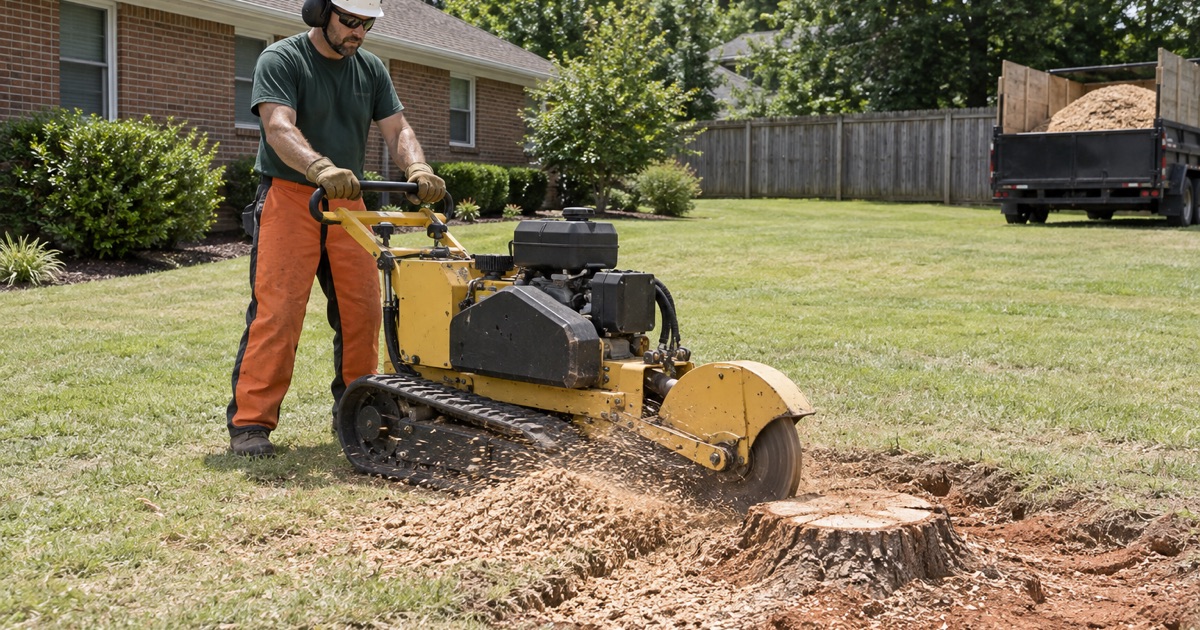
A grinder cuts the stump and the root flare into chips below grade and leaves the lateral root system in place to break down over the following years. An excavator pulls the root plate out whole, which means a hole, a spoil pile and tracked ground across the yard to get the machine in and the material out. On a finished residential lot grinding wins on cost and on damage nearly every time, and excavation earns its place only where something structural is going back into that exact footprint.
How Deep the Machine Genuinely Reaches
A tracked stump grinder is rated to cut somewhere in the region of 12 to 25 inches below grade depending on the machine and the wheel. The soils here go far deeper before they stop anything — Cecil and Pacolet run past 60 inches and Madison past 72 inches to bedrock — so the equipment’s own geometry limits the job three to six times sooner than the ground does. Depth is therefore something to specify, and paying for more of it is a real decision rather than an upsell.
Surface Roots and the Radius Around the Stump
Grinding the stump does not touch the roots running away from it, and on a mature hardwood those can be lifting a walkway path twenty feet out. Where the goal is a level lawn rather than just the stump gone, the quote needs to include grinding the major surface roots back within a stated radius. That is more machine time and it should appear as its own line, not as an assumption either side made quietly.
Depth, Backfill and the Ground Afterwards
Choosing a Grinding Depth for What Comes Next
A lawn you intend to seed needs perhaps four to eight inches below grade, enough for soil and root depth. A fence post, a patio footing or a replacement tree in the same hole needs considerably more, and a replacement tree also wants the grindings out rather than left as backfill. Tell us what is going there and the depth answers itself; guess at it, and the second visit costs more than the extra depth would have.
The Grindings: Backfill, Haul or Replace
One mature stump produces a surprising mound of chips, roughly two to three times the volume of the stump itself once the material is broken up. Left as backfill they settle over a season and leave a dish; hauled away they become a disposal cost; replaced with topsoil they give you ground that actually grows something. Every one of those is legitimate and they cost different amounts, so the estimate states which one you are buying.
Leveling, Topsoil and Reseeding
Where the finished result matters — a front lawn, a spot the mower crosses — the last step is taking the excess grindings off, bringing in soil, raking to grade and seeding. Wood chips tie up nitrogen while they decompose, which is why a crater seeded straight into grindings comes up thin and patchy. We say in writing whether seeding is included, because a quote that ends at the words stump ground has left that entirely to chance.
Piedmont Soil, Slope and What Wears a Machine Out
Quartz and Rock Fragments in the A Horizon
The ultisols under this service area carry quartz and up to 35 percent rock fragments through the upper horizon, and that abrasion — not the wood — is what takes the edge off grinder teeth. It is why a stump in one yard prices differently from the identical species and diameter two streets over. We would rather price the wear into the job honestly than discover it halfway and go looking for a change order.
Slope, Setup and Where a Machine Can Stand
Pacolet slopes here commonly run 15 to 25 percent and range considerably wider than that. A grinder needs a stable stance to cut, and a stump on a bank sometimes has to be worked from an awkward side with less reach available, which is slower. Reading the approach at the estimate is how a difficult setup becomes a scheduling note rather than a crew standing in a yard deciding what to do.
Buried Utilities and South Carolina 811
Every grind gets a South Carolina 811 notification before anyone starts, because a stump grinder is breaking ground and the marked locates take working days to come back. Public utilities get located and flagged through that system. Private lines do not — irrigation mains, low-voltage lighting, a gas run out to a grill, an old septic line — so anything you know about on the property is worth mentioning while we are writing the estimate.
Stumps After a Removal, and Stumps Left by Somebody Else
Grinding as Part of the Removal, or Later
When we take a tree down, grinding the stump on the same visit is cheaper than coming back, because the mobilization is already paid for. Some owners prefer to wait, spread the cost or see what they want in that corner of the yard first. Both are fine; what we will not do is leave the stump off the estimate and let it arrive as a surprise second invoice.
Old, Weathered and Overgrown Stumps
A stump that has sat for years is often harder work rather than easier, because it has collected soil, gravel and sometimes a good deal of ivy, and every bit of that grit goes through the teeth. Rotten wood also loads the wheel unevenly. We quote these on what we can see and say plainly when the price depends on what is under the debris.
Multiple Stumps and Whole-Lot Clearance
Where a lot carries a dozen stumps from an earlier clearing, the economics change: the setup is amortized and the cost per stump drops sharply. That is the case for doing them together rather than one at a time as each becomes annoying. On a wooded or overgrown lot it is also worth asking whether a forestry mulcher handling the whole area is the better answer, and we will tell you when it is.
- 20+ Years in the Upstate
- Free Estimates
- Written Tree Condition Reports